Magical Fairy Houses Coloring Pages Graphics
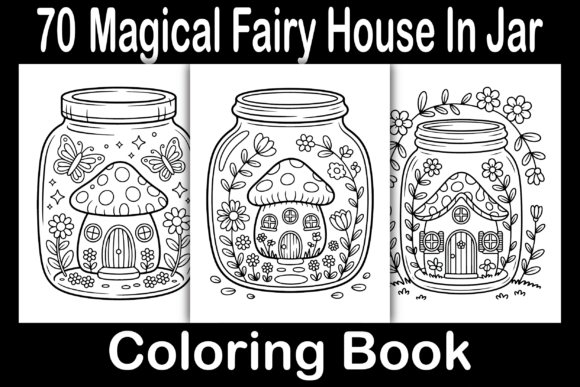
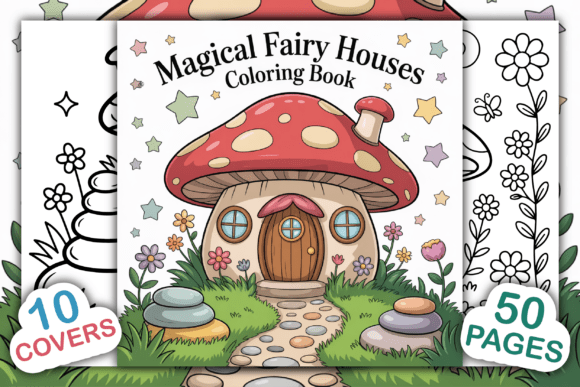
As a digital product creator who’s launched over 200 Etsy listings and managed print-on-demand collections across Shopify and Creative Fabrica, I opened Magical Fairy Houses Coloring Book expecting charm—but what stood out immediately was its quiet commercial versatility. It doesn’t shout “trendy” or lean into overused whimsy. Instead, it offers soft-lined, high-resolution illustrations of enchanted cottages nestled under mushrooms, wrapped in ivy, or perched on tree stumps—each with gentle negative space, consistent line weight (around 2.5 pt), and subtle texture hints that hold up beautifully at multiple scales.
The mood lands somewhere between nostalgic storybook and modern handmade: delicate but not fragile, feminine without being saccharine, and detailed enough for adults yet accessible for older kids. That balance makes it unusually flexible across audiences—from Etsy shoppers buying printable nursery art to Canva template sellers building themed planner kits for spring launches. It feels decorative rather than purely functional, which strengthens perceived value in digital downloads where visual storytelling drives conversion.
In my test run for a new seasonal bundle (“Enchanted Spring Collection”), I used Magical Fairy Houses Coloring Book across six real product formats:
- SVG designs for Cricut users—clean cut lines held up well after vector tracing; no stray anchor points or overlapping paths
- PNG clipart with transparent backgrounds—tested on white and charcoal mockups; the line contrast stayed legible even on mid-tone backgrounds
- Sublimation-ready layouts for mugs and tumblers—scaled cleanly to 300 DPI at 4" width, with no pixelation in foliage details
- Printable wall art sets—paired with light serif fonts (like Playfair Display) and muted pastel palettes to reinforce brand cohesion
- Greeting card templates in Canva—layered behind hand-lettered phrases like “You’re Magic” with subtle drop shadows for depth
- Digital paper packs—repeated as seamless patterns at 12" x 12" resolution, retaining clarity in both full-page and quarter-tile views
What surprised me most was how well it supported product presentation. When dropped into mockups—especially lifestyle shots of framed prints on nursery walls or coloring books resting beside watercolor pencils—the illustrations added instant narrative warmth. Thumbnails stood out in Etsy search because of their distinctive silhouette variety (domes, spires, arched doorways) and cohesive color-agnostic line work. No single image felt generic, and none required heavy editing to fit a brand’s visual hierarchy.
This asset shines brightest in contexts where atmosphere matters more than stark minimalism: themed digital download shops, seasonal bundles (think “Spring Magic” or “Whimsical Nursery Launch”), printable planner inserts, and social media graphics promoting slow creativity. It works exceptionally well in large-format previews—like banner headers for a Canva template shop—or layered behind transparent text blocks in blog graphics about mindful crafting.
But it’s not universally plug-and-play. I recommend using Magical Fairy Houses Coloring Book carefully in these scenarios:
- Tiny sticker sheets: Some houses include fine interior details (window panes, tiny flower boxes) that blur below 1.5" height—best simplified or omitted for die-cut stickers
- Dark-background merchandise: While lines are bold enough for most use cases, intricate roof shingles lost definition on navy sublimation shirts—test print proofs first
- Cricut projects requiring precise internal cuts: One cottage included a winding vine wrapping *over* and *under* a window frame—required manual path cleanup before cutting
- Text-heavy templates: The illustrative density competes with body copy; reserve it for headers, dividers, or background accents—not full-page layouts with paragraphs
Before listing anything built from Magical Fairy Houses Coloring Book, I ran five quick checks:
- Previewed all files as 120x120px Etsy thumbnails—confirmed key shapes remained recognizable
- Test-printed three pages on matte cardstock and glossy photo paper to verify line consistency across substrates
- Loaded PNGs into a dark-mode Canva template—checked transparency integrity and edge sharpness
- Imported SVGs into Cricut Design Space—verified no hidden layers or embedded raster elements
- Reviewed the commercial license—confirmed it permits finished goods (e.g., printed coloring books, mugs, digital planners) with no attribution required
For small business branding, this graphic design asset pairs naturally with a range of typography: a clean sans serif (Inter or Montserrat) for modern planner kits, a gentle script (Dancing Script) for greeting cards, and a sturdy display font (Bebas Neue) for t-shirt designs that emphasize “FAIRY HOUSES” as a bold phrase alongside the illustration. I also grouped it with coordinating design assets—like mushroom borders, leafy frames, and fairy-wing silhouettes—to build cohesive clipart bundles without visual fatigue.
If you sell printable designs, SVG bundles, or themed Canva templates, Magical Fairy Houses Coloring Book isn’t just another coloring page—it’s a foundational graphic design asset that supports storytelling, reinforces seasonal relevance, and elevates perceived professionalism across digital download listings. It won’t replace technical precision tools for engineering-heavy Cricut projects, but as a decorative, emotionally resonant element? It delivers quietly, consistently, and commercially.
Just remember: test early, pair intentionally, and always confirm file integrity before bundling. Because in digital product creation, the difference between a decent listing and a trusted shop often comes down to one well-chosen, thoughtfully deployed illustration.