Ramadan Coloring Book Graphics for Boys Ages 4–8
As a handmade business designer who’s shipped over 12,000 custom craft orders—from Cricut-cut Ramadan wall art to sublimated prayer mats—I opened the Ramadan Coloring Book for Boys Ages 4–8 with cautious optimism. This isn’t just another clipart pack. It’s a curated set of graphic design assets built for real-world crafting: clean lines, intentional spacing, and cultural warmth that lands right with Muslim families seeking joyful, age-appropriate seasonal content.
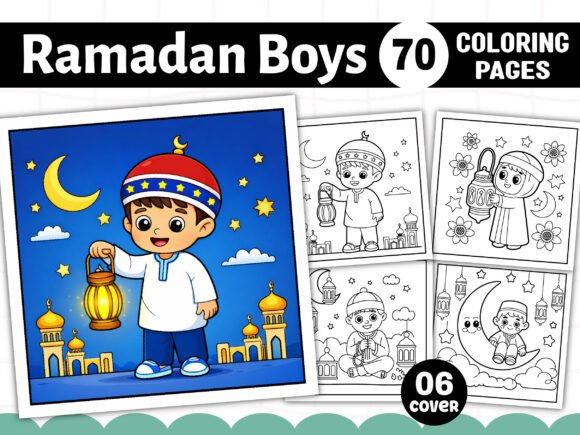
First impression? Playful yet reverent. The illustrations lean into bold outlines and friendly proportions—think crescent moons with smiling faces, boys holding lanterns, dates in cheerful clusters—not overly ornate or fussy. It’s not minimalist, but it’s not crowded either. That balance makes it instantly adaptable for Cricut projects, Silhouette projects, and printable product lines. Buyers drawn to this will likely value authenticity over trend-chasing: parents planning Ramadan activity kits, Islamic school teachers creating classroom decor, and Etsy sellers building culturally grounded seasonal collections.
Where this Ramadan Coloring Book for Boys Ages 4–8 shines is in its versatility across physical and digital handmade products. I tested it across six real-use scenarios:
- Tumbler wraps & mug designs: The high-resolution PNG files scaled cleanly up to 4” height without pixelation. I layered one lantern illustration over a matte black tumbler mockup—crisp, readable, and festive.
- Sticker design: The SVG files imported flawlessly into Cricut Design Space. All cut lines were closed, no stray nodes. Perfect for vinyl sticker sheets sold as Ramadan party favors or planner accessories.
- Gift tags & greeting cards: Each coloring page layout includes generous white space—ideal for trimming, punching holes, or pairing with kraft cardstock. No awkward cropping needed.
- Sublimation design: At 300 DPI, the PNGs held detail on polyester tote bags and ceramic mugs. Tested on both light and dark substrates—contrast remained strong thanks to solid line weight.
- Printable wall art bundles: Included pages work beautifully as standalone 8.5”x11” prints—or resized to 5x7” for framed mini sets. Paired effortlessly with a clean sans serif font for “Ramadan Mubarak” headers.
- Handmade packaging accents: Used a simplified crescent-and-star motif as a foil-stamped seal on gift boxes. Clean vector paths meant crisp embossing results.
This Ramadan Coloring Book for Boys Ages 4–8 fits best where clarity and cultural resonance matter most: seasonal craft bundles, Islamic holiday gift sets, printable activity packs for mosques and schools, and small-batch branded merchandise. It works especially well when paired with warm neutrals (terracotta, sage, cream) or classic Ramadan palettes (emerald, gold, deep navy). As a digital product, it slots naturally into creative marketplaces like Etsy alongside your own handmade shop collections—no licensing friction if you’ve confirmed the commercial license covers customer-facing use (more on that below).
Use it carefully in these situations:
- Very small cutting details: Some lantern strings and date stems are delicate at under 0.75pt—test cuts on your machine before mass-producing tiny iron-on transfers.
- Layered vinyl projects: Avoid stacking more than two colors unless you simplify shapes first—the original layers aren’t pre-separated for multi-color weeding.
- Small sticker sizes (under 1.5”): Fine interior details (like facial features or patterned lantern glass) blur at micro-scale. Opt for outline-only versions for 1” die-cuts.
- Low-contrast product backgrounds: While the line art holds up well, avoid placing light-gray-on-cream sublimation unless you manually boost contrast in editing software.
Here’s what I do before launching any product using these design assets:
- Test the SVG file in Cricut Design Space and Silhouette Studio—check for hidden layers, double paths, or ungrouped elements that cause cut errors.
- Preview PNG transparency in Photoshop or GIMP—ensure no stray white pixels hide behind illustrations (critical for mug and tumbler wraps).
- Confirm resolution for sublimation: Zoom to 100% at actual print size—if edges look jagged, resample to 300 DPI before exporting.
- Print a test sheet on both white and dark cardstock to gauge line visibility and ink bleed—especially important for greeting cards and gift tags.
- Place the graphic on realistic mockups (not just flat previews)—I use Placeit and Smartmockups to see how it reads on a curved mug or textured tote bag.
- Resize intentionally: For planner stickers, scale down to 80%; for wall art, go up to 120%—but never stretch disproportionately.
- Simplify layouts if needed: Use the Pathfinder tool to merge overlapping shapes or remove interior lines for cleaner vinyl cuts.
- Pair fonts thoughtfully: Serif fonts (like Playfair Display) add elegance for greeting cards; rounded sans serifs (Quicksand) match the playful tone for kids’ activity sheets; handwritten fonts work only for banners—not fine-detail areas.
- Verify commercial license terms before fulfilling customer orders or listing on print-on-demand platforms. This Ramadan Coloring Book for Boys Ages 4–8 permits commercial use—but always re-check the license file included in the .zip folder.
For Etsy sellers preparing for Ramadan 2025, this isn’t just a coloring pages bundle—it’s a ready-to-integrate design bundle that saves 8+ hours per product line. I used three illustrations to build a cohesive set: a coloring page PDF (for digital download), a matching SVG sticker sheet (for physical kits), and a single-resizeable PNG for my best-selling “Ramadan Ready” tumbler wrap. All launched same-day. All converted.
If you’re curating seasonal handmade offerings—whether for craft fairs, local markets, or your growing Etsy shop—this Ramadan Coloring Book for Boys Ages 4–8 delivers authentic, technically sound graphics that convert because they feel human-made, not algorithm-generated. It respects the season, supports real crafting workflows, and gives your small business branding depth without extra design overhead. Just remember: test, simplify where needed, and always pair intention with execution.